Author: Kenny Kissoon
-
4 Questions Shaping US Housing Affordability
Recent signs pointed to housing disinflation, with buyers and sellers increasingly mismatched and sellers offering more concessions, creating potential savings for households chasing homeownership.
The clearest current hurdle remained borrowing costs: benchmark Treasury yields hovered near ~5%, while the avg. 30-yr mortgage rate moved above low-7%.
In the four weeks ending Sept. 13, the median monthly mortgage payment reached ~$2.6K, ↑~3% yearly, reflecting how financing costs kept affordability stretched for buyers.
The resale market stayed sticky, with many owners holding low-rate loans and keeping listings scarce, while sellers still sought pandemic-era pricing in many deals.
Industry voices described the US market as a correction toward stability, not a crash, with strong equity, sound lending, and opportunities for buyers and sellers. -
Ozone Park Sellers: Price per Square Foot Is Up
From August through October 2026, Ozone Park's median sold price per square foot rose 8.3% year over year to $564.96. The median asking price also increased 5.0% to $840,115. These are useful benchmarks for sellers, though they don't establish the value of an individual home.
Continue to full article -
U.S. Home Prices Beat Expectations
A national home price index showed US single-family prices ↑~3%, topping the ~2% forecast and signaling stronger-than-expected housing momentum across major metro markets.
That reading also improved from the prior ~2% level, suggesting the market kept gaining ground as demand stayed firm and available homes remained limited.
Because home prices often reflect broader confidence, this stronger result pointed to healthier economic activity and supportive conditions for housing-related spending and investment.
A resilient housing backdrop can also help adjacent US industries, with construction and home improvement positioned to benefit when buyer confidence and activity hold.
At the same time, firmer price growth may keep affordability in focus, so policymakers and analysts are likely to watch stability and buyer access closely. -
Neighborhood household profile
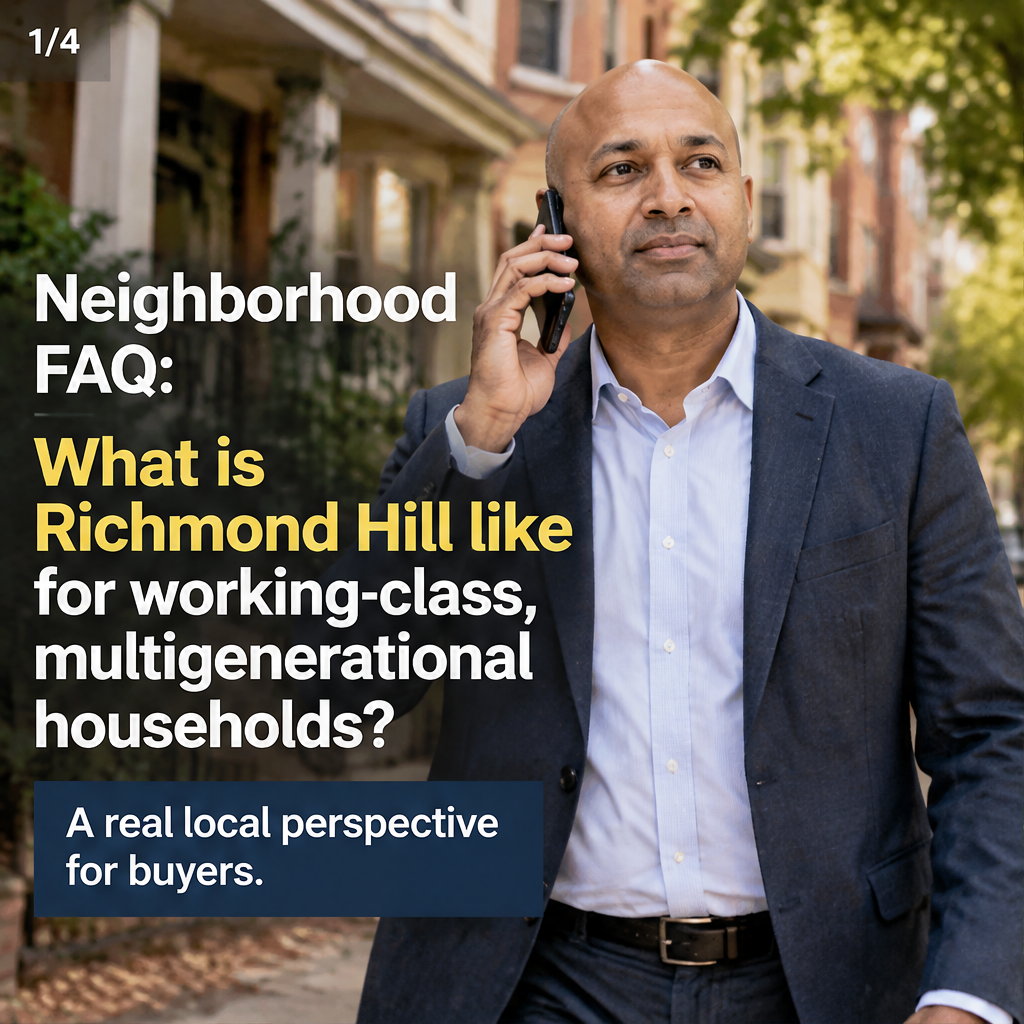
Richmond Hill, New York, has a predominantly residential character that suits many working-class, multigenerational households. Victorian-style homes with front porches sit alongside multifamily housing, supporting both homeowners and renters across generations.
The neighborhood’s commercial life is easy to explore. The Liberty Avenue corridor reflects Indo-Caribbean, Guyanese, Indian, Latin American, and Asian communities, while Jamaica Avenue provides another active shopping area.
Transportation includes J/Z service and local buses. Manhattan commutes can be longer than from Forest Hills, so buyers should consider daily travel needs when comparing homes. Older-building maintenance is another important part of the purchase review.
Buyers should also review flood-related ADU limitations as part of their due diligence. If you are considering Richmond Hill, New York, message me to talk about your move.
Continue to full article -
Condos sold in Queens under 500 square feet cost more than three times per square foot those over 2,500: Report
In Queens, smaller condos under 500 sq ft sold for $1,075 per sq ft, second only to Manhattan, while larger condos over 2,500 sq ft sold for $305 per sq ft. Since 2015, condo prices per sq ft rose 33%, with the biggest gains in 2,000-2,500 sq ft units. The median condo size sold was 779 sq ft. Hunters Point had the highest median price per sq ft at $1,307, with smaller units being the most expensive.
Continue to full article -
Millions of homeowners could finally get a tax break that’s been frozen since 1997
A bipartisan bill aims to double the capital gains tax exclusion for home sellers, increasing it from $250,000 to $500,000 for singles and from $500,000 to $1 million for married couples. This change, frozen since 1997 despite rising home prices, could encourage longtime homeowners to sell, boosting housing inventory and addressing affordability concerns. The bill has gained support from about one-third of Congress.
Continue to full article -
S&P/Case-Shiller Home Price Index Surpasses Expectations
The S&P/Case-Shiller Home Price Index for 20 metropolitan areas rose 2.7%, exceeding the forecasted 2.6% and the previous 2.5%, indicating a strong housing market. This increase reflects steady demand, low mortgage rates, and limited supply, contributing to economic growth. However, concerns about affordability and a potential housing bubble remain, emphasizing the need for ongoing monitoring of market trends.
Continue to full article